


In the modern world of business, there exists two broad categories of corporations: public, and private.
The distinction is typically made as a matter of whether or not control of the corporation is available in theory to the general public at large, and barring some miscellanea about stock-based ownership and distinctions of form with democratic state-owned enterprises, that qualification is what raises what is, by default, a private corporation into the ‘big leagues’ as a public corporation.
But what if I told you that it was also possible to take a company in the other direction? What if, say, instead of a corporation striving for transparency and public goodwill in service of its charter granted on the premise of commerce, it instead chose to exclude public participation at all meaningful intervals? This is called going confidential, in contrast to going public, and it’s an increasingly common phenomenon in the world of tech.
Exhibit A: Olofsson’s Gambit
To understand what going confidential means and begin to explore why executives of such companies would do such a thing, let us examine what I have found to be a highly legible and blemish-free example: the confidential corporation formerly known as Adapteva, a.k.a. Zero ASIC.
A normal(-ish) company
Once upon a time, way back in the halcyon days of 2008, Andreas Olofsson founded a company with a simple mission: bring a 10× advancement in floating-point processing energy efficiency for the mobile device market. And as a company is wont to do, within a year he had a working prototype thereof. This allowed him to secure more investment funding from the massive conglomerate now known as BittWare-Molex (yes, that Molex), and the rest was history. Or was it?
Breaking bad
Well, as often befalls ambitious technical startups, product-market fit rendered for Andreas as 404 not found. Ordinarily this would be the point where we call it a day, chalk it up to a lesson, and life goes on. But no, this was merely the ‘humble’ beginnings for Olofsson, who would make his debut breaking bad into the post-pandemic zeitgeist of tech mafia racketeering by rebranding this company of his as Zero ASIC. Coterminous with this rebrand are two major public-side changes:
Gone are the pretensions of purpose for the public at large. Where Adapteva promised concrete numbers that left the implications open to the reader’s imagination, Zero ASIC offers calorie-free platitudes self-describing as a “U.S. semiconductor startup on a mission to democratize silicon.”
Gone are the pretensions of public involvement or knowledge. Where the old website had carve-outs for public events and a web form to reserve your own development board in the course of their limited runs, Zero ASIC offers nothing but deliverables crossed by file format.
Members only
It’s almost like the new site is meant only for people who have a key. The website gushes endlessly with blog posts about how they’re “revolutionizing silicon”, but never shows anything material that anyone in the public could get their hands on. Instead, they offer photographs and charts that constitute ‘proof’. It tries so hard to be transparent and open, but only to the kind of person who has a chequebook and a glass ego the size of Deep Thought. From a different angle, the target audience looks to be shot-callers, and the framing of ‘proof’ starts to make a lot more sense as it would in a black market. Are they operating in one?
This is assuming the company’s claims are to be believed. Of course, it’s not like we have any reason to doubt the veracity of the claims—inasmuch as they bother to make concrete claims that could be falsified, which increasingly they do not—but there is a deeper violation of trust at hand here. Let’s start with this heaping pile of lawyer-esque lies:
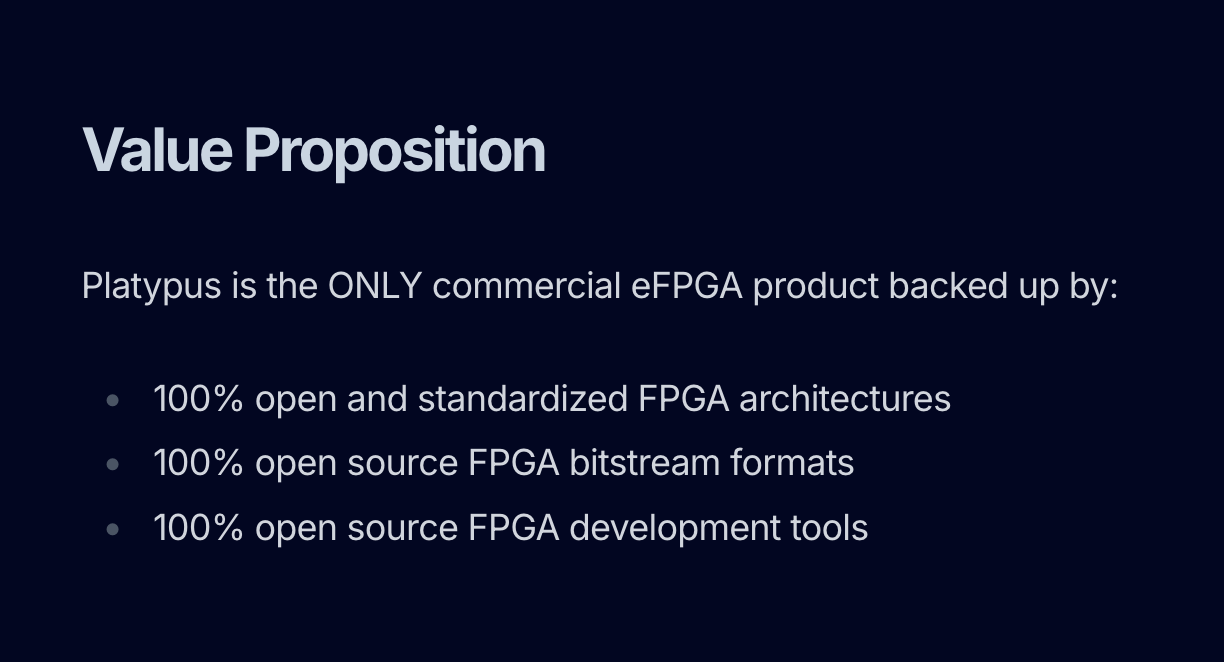
You would be forgiven for thinking this is a company that is all-in on open source. That’s what this newspeak hopes to convince you of if all you do is skim. But they’re really saying nothing more than a food advertisement is saying when they call something natural or gourmet. It’s really embarrassing that a company would so openly try to pull everyone’s pricks like this, but that leads us into the darker revelation here: they don’t care what the public may think, and that’s the big overarching reason why they went confidential instead of remaining as Adapteva.
It’s for Fake Steve Jobs
The form of these pages is tailored to an audience of nouveau-elite and pseudo-elite millionaires who have made technobabble squatopianism their whole personality within the last ten to twenty years. They’re people who categorically never get their hands dirty and on the whole have no idea how any of this technology works or what would be best to do with it, but are self-appointed geniuses and savants by virtue of their control of the chequebooks and are all very self-assured about their vapid collections of pseudophilosophical meanderings that specify a general direction for technology to take that would be ‘good’. An excellent live example of this type of person is Maxim Perumal, the apparent pet of tech mob bishop Naval Ravikant:
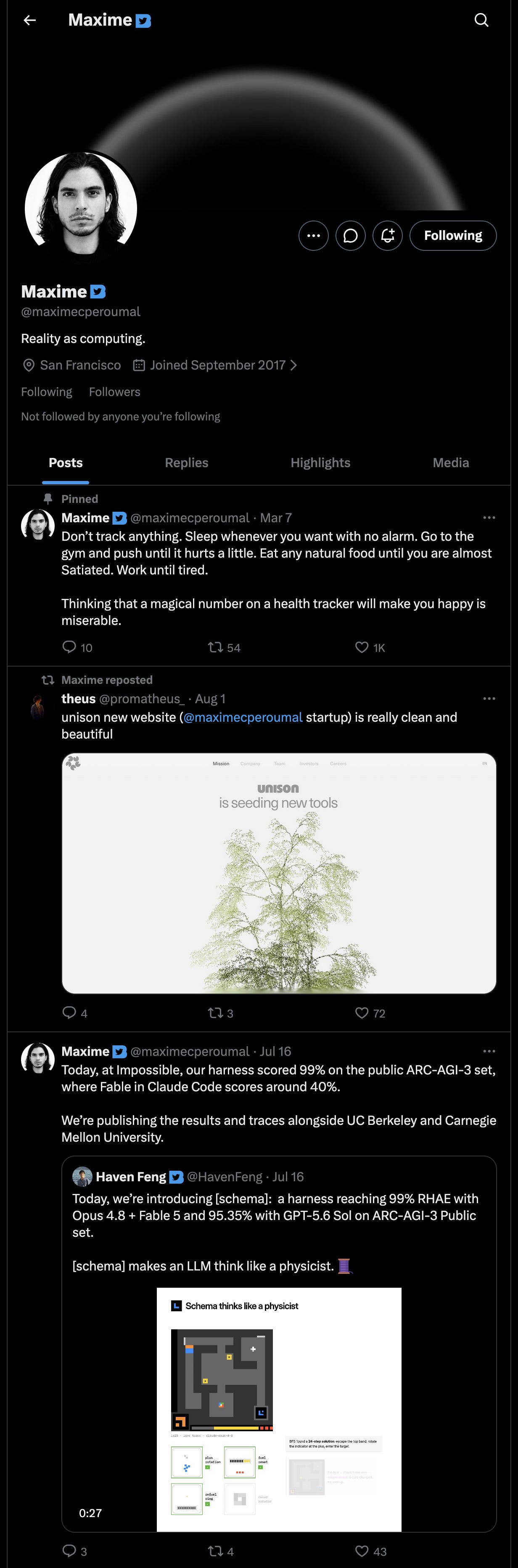
He has been changing as he approaches 25 to be sure, but at the time I knew Maxim he still spelled his name as I have here, wore Steve Jobs glasses, and was generally a relatively clueless but earnest 19-year-old French son-of-nobility. I got the job at what was then Unai as I have detailed in the Scourge of the Tech Industry and originally in gratitude in the Scourge of Austin City. That company is now called “Unison” and has been for a while, but I’ll stick to the original name as it’s what I knew it under. Like many confidential companies, Unai had no product and no realistic path to one, but that was all excused with the canned lines hearkening to Apple and FAANG you’ve all heard a thousand times by now.
Breadcrumbs
As I said in the Scourge of the Tech Industry, I couldn’t help but notice an obvious conflict of interest: their software guy had a stranglehold on the company’s codebase. Now I will tell you about another hugely problematic thing I noticed looking back: at the time Maxim was telling us throughout various stand-ups about their efforts to acquire office space in the Santa Clara Valley, despite the fact that multiple team members lived hundreds (or in my case thousands) of miles away from California with no real path to visitation nor impetus to do so. He explained to us what his investor-mentor was telling him, which amounted to “ever since the GFC, signing a commercial lease has been hard in the Valley, but don’t worry, I know a guy and if you sign with him you should be able to get it.” I thought it nothing more than garden variety corruption—immoral but legal—until I recalled another thing Maxim said offhand about the conversation he had that got Unai as it were funded: that it was likely a key factor he decided against looking towards production at all. This was another story he recalled quite faithfully, showing how he was probed and questioned very gently to see if he could give the ‘correct’ answer. Connecting those two things made something once obscure painfully obvious to me: this company is probably a money laundering front.
Just a theory
I’ve told this story more or less as you read it laid out here for months on end to prospective investors in Southeast Asia to relate my pains and explain the oddity of why an American is coming to such a faraway place to get funding for Anodyne. The response was uniform: concurrence and assuagement in the vein of common sense. Some of them even laughed as I went through the plot of it all point-by-point. That confirmation coupled with my elite disposition there sealed my conviction for good about this.
Now, in the parlance of Thomas Sowell, I don’t have any hard evidence of such a claim. And furthermore I don’t think Maxim was aware of this at the time, although as time goes on I think he can’t remain hog ignorant of the environment he lives in forever. Indeed, as time goes on it will really just be a personal failing of avoiding discomfort if he does keep himself stupid to what I could figure out in a matter of weeks working under him with unsundered hindsight. But the more alarming thing is, if I could infer something like this, I’m sure federal and international law enforcement agencies could find the hard evidence to back it up, if it exists, and so far there hasn’t been a hint of such an investigation in any company of this type. Do I have to say they’re in on it too? Well, by Occam’s razor…
I’ve spoken plenty already about how cowardly the dishonesty and manipulation is from the tendrils of the tech mob. In the past I’ve drawn attention to several high-profile events that have their prints on it. If there were an honest FBI it stands to reason at least some of these should have ended in Madoff-style convictions and satellite suicides, but I think we all understand by now that we don’t live in a world like that. Confidential companies sure do have some incredible privileges, apparently.
Not companies, but outfits
The best way to understand how confidential companies would acquire such incredible privileges—such as immunity from the law in the commission of the gravest of crimes—is to recognise that they are not really companies. This also solves the dilemma posed by some companies being more privileged than others when the economics at hand do not allow for that.
See, companies exist in the paradigm of commerce. Their purpose is to conduct business, whether that’s production, middlemanning, service work, or some unique hybridisation thereof. You’ll take notice right away that most of these confidential companies—Zero ASIC and Unai being exemplars—have no pretence with any of that.
So if they’re not companies, then what are they? They’re best understood as outfits, hence why the terms tech mob and tech mafia have such immense staying power. And much like the historical American Mafia a.k.a. the Italian Mob, their ‘business’ predominates in trafficking, racketeering and, above all, money laundering. Confidential corporation is a term of art that pays sarcastic deference to their disingenuousness as they pretend to be businesses when you read about them on Wikipedia or in the AP.
Racketeering
Out of the three, racketeering is far and away the easiest to identify because it’s hiding in audacity under everyone’s noses. They’re established billion-dollar companies like Alphabet and Meta Platforms, and they run services that have successfully deployed Peter Thiel’s famous anti-commercial dictum: “competition is for losers.” The American public has tried for decades now to articulate the obvious problem with this, failing as their political will has been subverted – narrowly and artificially constrained by expert-guided ‘discourses’ that limit it to the confines of the tiny, feckless and downright archaic Sherman Act. We’re ‘informed’ by mass media as if it’s impossible to pass another law that does outlaw whatever the fuck this beast is doing to us, and that’s how you know you’re being had by the pigs.
Trafficking
These ones are the hardest to conclusively identify, but as with money laundering they’re the kinds of operations any honest law enforcement agency would have cleaned up long before yokels like me could write about it like this. My advice if you want to look around for them is to pay attention to neighbourhoods like Hunter’s Point in San Francisco. Why? Well, the tech mob has been locked in a prolonged real estate proxy war under the banner of YIMBY that they have been losing, as more established factions in SF have seen through the act and are doing the needful to show them the door. Their consolation prize has been a neighbourhood that is infested with cartel drug dealers who have come to an understanding with their white collar counterparts to keep it low-key so they can have their little pet brainiacs run amok and play Dexter’s Lab. It’s all well and good because these are not businesses. Take it from the opening pitch:


If these businesses were engaged in trafficking—and considering the current geopolitical climate there has never been more incentive for such—who in the public could tell? Some of these kids aren’t just crashouts in the making playing house on drugs; some like Sam Zeloof run a semiconductor fabrication plant and haven’t a damn thing to say about product, service or market at all. But y’know, as I said, we got Hoover’s FBI on the case, so don’t expect anything besides some sad Cowboys & Indians reenactments by balding obese middle-aged white divorcés with broken dicks. And given the stakes with these cases, I wouldn’t even expect that.
Money laundering
If trafficking was booze and racketeering was sex, money laundering has to be oxygen itself, because it’s the crowning continuum that keeps any criminal empire like this running. And boy howdy do the tech mobsters get some when it comes to that. This is what the modern ‘startup’ ecosystem is all about!
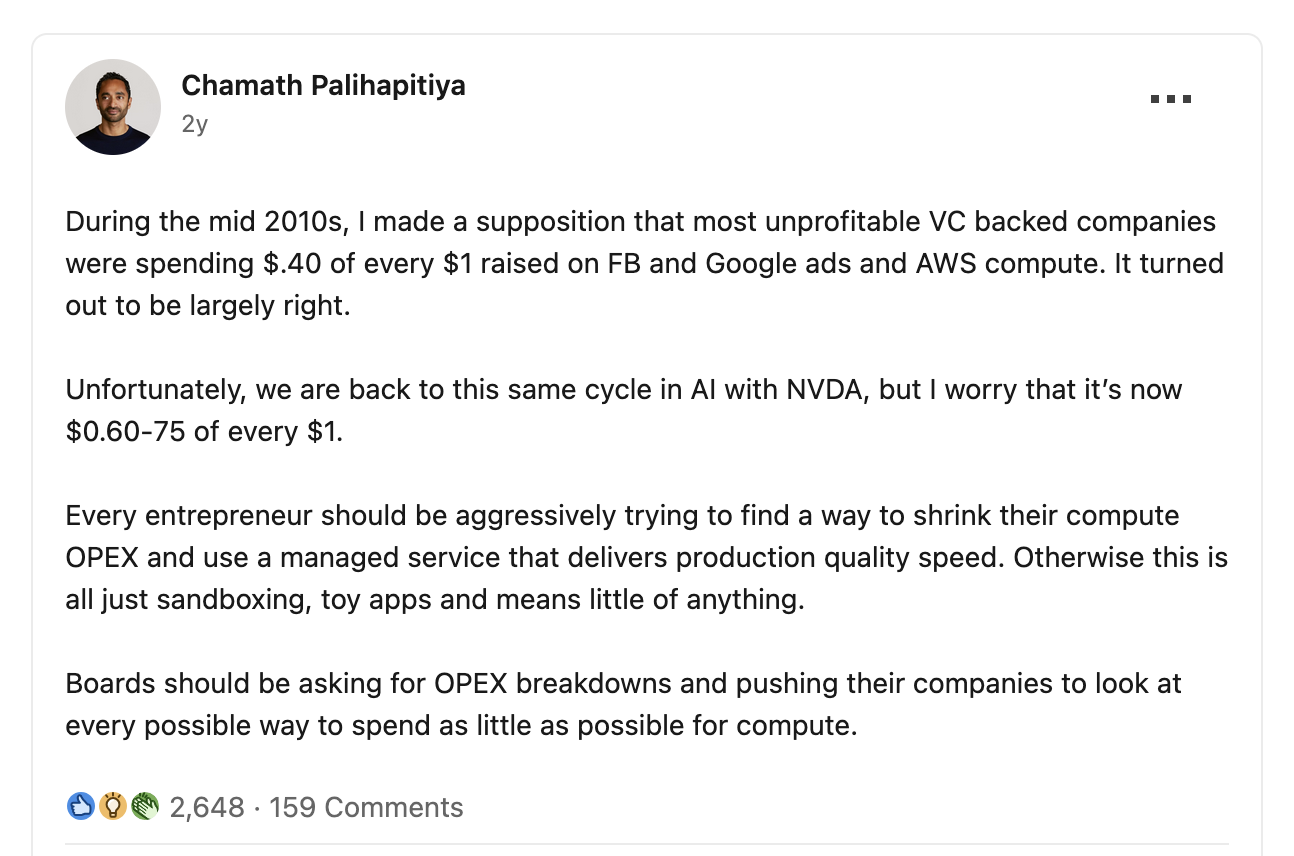
Andreessen–Horowitz aren’t luminaries because they made a few million dollars once upon a time – look at them now, they’re not even cracking the top 100 in terms of wealth. No, their world-class reputation follows from the innovation—if you could call it that—of doing money laundering under the guise of venture capitalism. It’s so magnificent because it makes the distinction between components of a proper front configurable in ways they never were before – one company that’s doomed to failure (like Maxim’s, perhaps) can serve as a paypig to route money back through rental agreements, while another company like Amazon can be on the receiving end of huge AWS contracts that launder the money upwards that way. Chamath even spilled the beans on this in public once, although he held back and only accused the operation of being an idle Ponzi scheme rather than the full-blown global money laundering operation it now likely is:
He reiterated this claim again for the current kayfabe:
But the best part? It’s all quantified. Which company plays which role? I dunno, I guess it depends on how ‘successful’ each of them are! Would you like to gamble on that by buying some options? Holy insider trading Batman! So, wouldn’t you like to be friends with the guys who wrote the book on all of this, just for the sheer audacity of it all? It’s like schmoozing with a modern Captain Cook or Napoléon Bonaparte. Who in their right minds wouldn’t? Right?
This is all your money
With the SpaceX pump-and-dump onto the NASDAQ, people are starting to understand that this is their money at work. What may be less obvious however is that their money is not even working for them at all anymore, simply because the outfits that the money has gone to are not businesses, having no pretensions of commerce or public-facing economic activity. The purchasing power of your dollars is being zapped so that organised criminals with handles in the stock market and the world of venture capital can live it up and mould the world into whatever shape they fancy.
We know the company isn’t worth $2.5 trillion. The number nonetheless insists as a testament to how much they can forcibly shake out of the system, hell or high water. Since we don’t prosecute people for engaging in organised crime, and we don’t have much protest against the casual consolidation of businesses into oligopolies in every facet of American life, we have laid ourselves quite helpless to having our culture forcibly redefined and our material lives upended to make way for this nightmare. The only thing I can wonder about at this point is, what are Americans going to do about it?