


In the course of my run for office, my husband often touted a simple dictum about the nature of my candidacy: if they find out about me, they vote for me. Now I have brought in data that vindicates this view, bolstering the credibility of the preposition that the Barringer campaign believed so too and conspired with the Democratic parties to effect a concerted suppression to make him look like ‘the only candidate’.
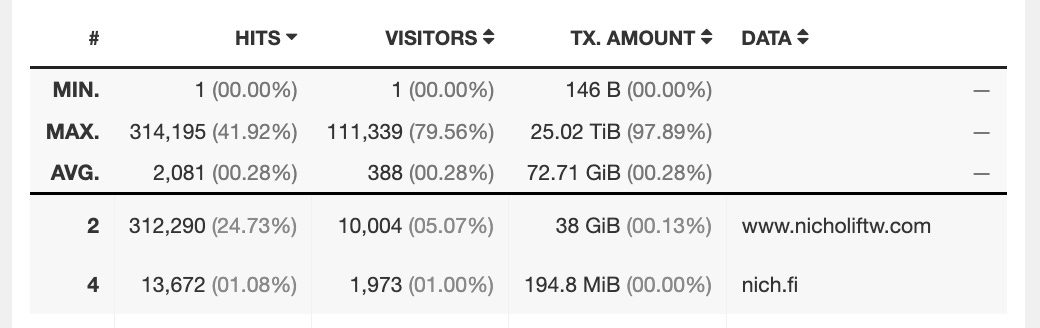
These are access logs from my web host. They contain the metadata of every connection that has ever been made to my websites, including where in the world they came from, what browser they used, whether or not they are unique, and more. I’ve cut some line items to centre the numbers in question here, which are that for nicholiftw.com, my campaign website. This data is current as of this writing and asserts just over 10,000 unique visitors to the page. There are several margins for error:
Multiple people using the same computer or the same connection might show as only one unique visitor
Distinction of robots from human visitors is not fool-proof
The data is as of 40 days after the primary date
All of these margins only point in one direction though: the estimate is utterly conservative for the simple measurement we wish to take, and that is vote conversion. Lower numbers from quality control corrections can only mean a higher true rate.
Recall what I said before at the conclusion of this race:
At the most basic level, an election held for a political office is a contest to win the moral judgement of the public.
Obviously, the obtainment of votes is the proof of winning this contest.
Most plainly, the contest is decided by an absolute threshold of votes; ergo, whoever takes the most votes wins. But this is predicated on an ethic of equal access to candidates! One cannot presume the most-desired candidate genuinely won if some candidates were not considered at all.
Democracy itself is predicated on equal access for the voting public to judge the candidates that stand in a race. This race was deeply undemocratic, and the conversion rate from views to votes is the empirical evidence we can supply to prove that it was so molested by Barringer and his corrupt contacts in the Democratic parties.
What we are looking at with my campaign is, in the worst possible case, a conversion rate of ~58%. Anyone with experience in the world of sales or marketing will immediately recognise that this is incredible. It means I’m an awe-inspiring rock star candidate and people loved what I was doing. I had zero advertising spend, built the website myself and hired one firm for fundraising that combed a meagre 100 leads and raised a pittance (I got more donors myself from in-person event appearance). So there are no other sources of data to examine that would be mutually exclusive in measurement from my website. I had about 10,000 people see me, and 5,775 of them went and voted for me. That’s something anyone should be proud of.
Now for the other shoe. Obviously we aren’t going to get the same fidelity of data about the Barringer campaign. However, we can still make a very educated guess as to the magnitude of his eyeballs. After he recognised that I was a serious candidate, Paul dropped a quarter-million dollars on a combination of ad spend and consulting. It’s safe to say he at least garnered at least that many views ($1 for a single view is way beyond the norm so this is super conservative). That’s 1 vote for every 10 people who see him, which is far more in line with typical sales experiences, and it’s still a very generous estimate in his favour (a more realistic number is somewhere between 1 in 20 and 1 in 50, which is 2-5%). Fact is, Paul paid a lot of money to find out that people found him repulsive, and took responsive measures to insulate himself from that by restructuring his campaign around his own shallow calls to credibility while pretending the competition simply does not exist. The reality still stood that his conversion rate—the empirical way to find out how much the people like you—was an order of magnitude lower in percentage than mine.
It’s tempting to take spending and compare it to votes earned, but doing so collapses a much more important metric that stands in between them: exposure bought. The world of advertising runs on conversion instead of sales outcomes because it’s the client’s responsibility to make and close sales on the products they offer. If the product is tough to sell or it just sucks, the firm and their client must have frank conversations together and collaborate intensely to make things work. Contrary to the American corporate culture of simply purchasing your success on the open market, the innate quality of what you are trying to sell still takes centre stage. In the case of Paul Barringer, what he was selling sucked, and mine not so much.
This is where we realise that the contest was subverted. For a given amount of exposure, Paul comes in a distant last place, and I take the lead with one hand behind my back. After consulting firms informed Paul of this reality, he conspired to SPAM the public with his presence and engage in corruption with other Party officials to create a hidden reputational cost to being judicious with candidate access. Paul was told that he needed to subvert the democratic process and do so in a massive way in order to steal the contest outcome for himself, and so he did.
Increasingly common is the curious disposition taken by those in power when it comes time to reckon with things like this that suddenly the narrative abandons those spirited concerns of the public. Some people will confidently gesticulate about all of the corruption but come up far too short-handed in experience or evidence, and it’s high time this sort of negligence stops. It’s not good enough to play the part and take umbrage but dip when the conversation gets too real, as it does here and as it did with the recent scandal surrounding WCDP chair Wesley Knott. Far more Americans realise the ploy and will settle for nothing less than an earnest avenue for fighting brazen corruption like this. As I said before, this is the spirit in which my campaign continues. I’m not continuing for a personally beneficial outcome; I’m continuing to arrest that which subverts all of us every damn day. Enough.